


Last month I awoke to a parade of large trucks carrying what looked like an erector set, an old-fashioned furnace with several flexible arms, and huge box truck that contained what looked like the largest roll of toilet paper I have ever seen! Then a huge crane truck showed up. Everything was parked along my front yard and up the street towards Burnt Store Road. My Yorkie was having a fit with all the commotion!
It took me a bit to figure out what was going on, but it quickly became apparent they were going to work on the culverts that run under Rio Togas connecting Ibis Lake to Stork Lake and ultimately Bear Branch Creek. Over the last few years, the rip rap at the outflow from Ibis Lake had started to sink into the ground. There are deep holes between the sidewalk and the rip rap, and a portion of the sidewalk has collapsed. The culvert was failing. A collapsed culvert can bring down an entire roadway, detouring traffic and costing taxpayers money in emergency repairs.
Charlotte County decided that the culvert needed rehabilitation, and rather than dig up and replace the culvert, they opted for a culvert lining process for repair. This method allows culverts to be restored instead of replaced. Culvert lining eliminates the traffic disruption, increased cost, and permitting difficulty that comes with conventional replacement.


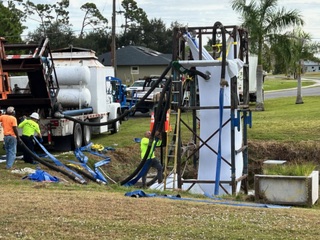
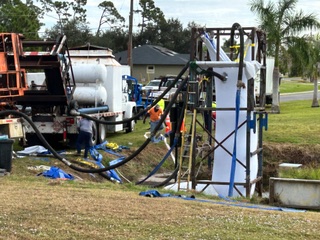
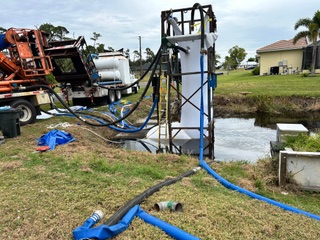
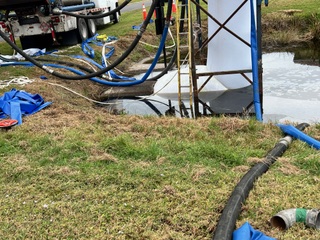
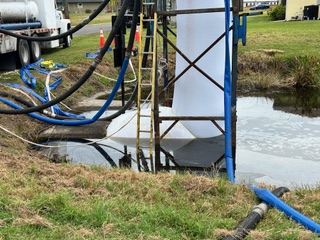
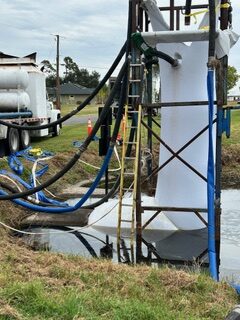
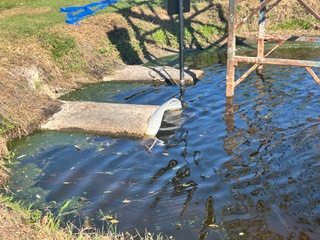
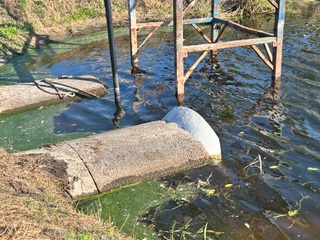
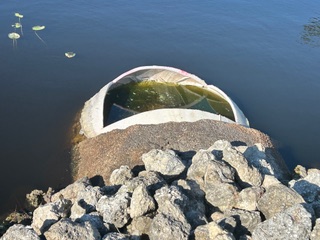
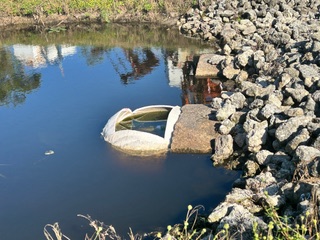
So, what happened next? First the crane placed the “erector set” at the end of one culvert pipe. Then the box truck opened up, and the crane lifted one end of the “toilet paper” (which was actually a flat, flexible, resin-saturated tube) and workers fed it down through the “erector set” where it was pulled into the existing culvert and fed through to the other end where it was sealed shut. Once fed through the pipe, the “furnace” was moved into place, and the “arms” were hooked up to the liner tube. The “furnace” was turned on, and the liner tube was expanded with air pressure and exposed to heat to stiffen it. Once hardened, the liner formed a seamless, jointless pipe inside the existing culvert. The noisy curing process took up the rest of the day. Once the liner pipe was hardened, the closed ends of the pipe were removed, and we have a newly rehabilitated culvert that will last for many years to come.
A couple of days later they started the entire process over again to repair the second culvert. The only thing left is for the riprap, deep holes, and sidewalk to be repaired.
As you can see from the photos, it was interesting to watch, and I learned a lot about the process. I guess you are never too old to learn something new!