

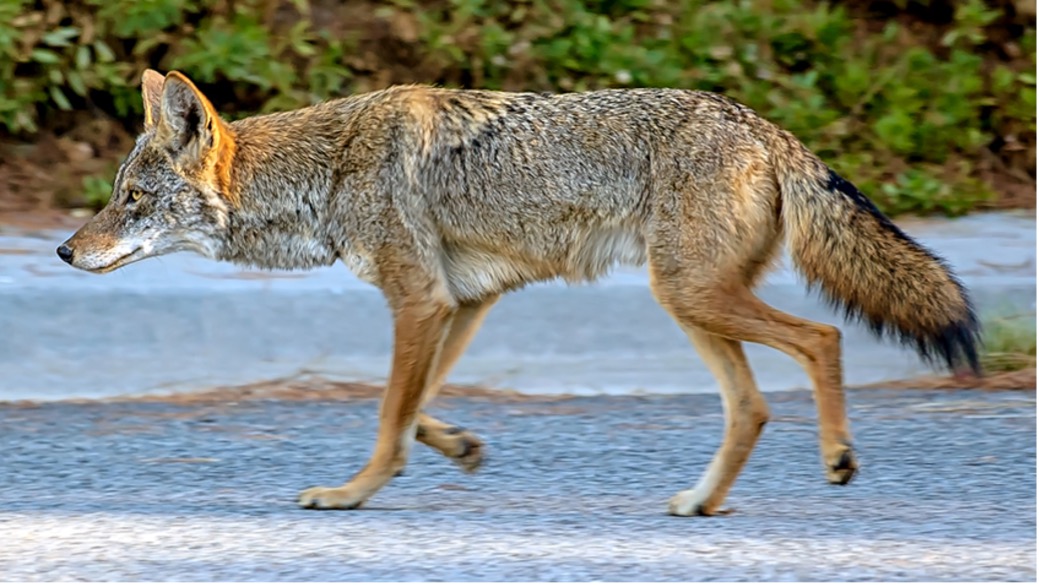
Coyotes are found throughout Florida. This adaptable animal belongs to the dog family and resembles a small German shepherd. In Florida, coyotes typically weigh between 15 to 30 pounds. They have pointed ears, a narrow muzzle and a bushy tail. Males tend to be larger than females. Coyote fur is usually grayish brown but occasionally is black. When running, the coyote usually holds its tail at “half-mast” or straight out behind it, unlike most domestic dogs.
The scientific name of the coyote, Canis latrans, literally means “barking dog.” Coyotes use a variety of vocalizations, such as barking like dogs, but most often they are heard making shrill yips and howls. Howling is often a group effort that begins as a simple howl but quickly increases into a series of group howls and high-pitched barks.
Coyotes typically are shy and elusive, but they occasionally can be spotted either alone, in pairs, or in small groups where food is readily available. Never feed coyotes, and do not don’t place food outdoors that will attract any wild animal. Clean up pet food, fallen fruit, and seed around bird feeders. Secure garbage cans and compost in animal-proof containers.
Keep your pets safe. Coyotes can and do prey on domestic cats and small dogs. To protect your pets, don’t allow them to roam freely. Most coyote attacks on pets occur either at night or at dusk or dawn. During these times especially, be careful if you’re walking your pet in wooded areas or in heavily foliaged areas where coyotes could hide. Keep your dog close on a short leash. Keep cats indoors. When cats wander freely, there’s an increased risk of them being attacked by coyotes.
Be aware of unusual coyote behavior. Examples include coyotes approaching people, stalking pets, chasing joggers or bikers, or attacking leashed pets.
Teach children to recognize and not to run from coyotes. If children are approached, have them move slowly into a house or climb up on a swing, tree, or deck and yell.
Coyotes can be curious but are also timid and generally run away if challenged. Just remember that any wild animal will protect itself or its young.
Never initiate a close encounter with a coyote. If a coyote approaches too closely, immediately act aggressively toward the coyote. Wave your arms, throw things like stones, and shout at the coyote. However, don’t attempt to hurt it, because injured animals are more likely to attack. If necessary, make yourself appear larger by standing up or stepping onto a rock, stump, or stair. Convince the coyote you are a potential danger to be avoided.
Where coyote encounters occur regularly, walk pets at other times besides nighttime hours, dusk, and dawn. Carry something that will make noise or scare the animal, such as a small air horn, big water pistol, solid walking stick, golf club, or paintball gun. These things may deter the coyote at close range. Make a “coyote shaker” by putting a few washers, pebbles, or pennies into an empty soft drink can. Wrap the can in foil and tape closed. Continue “hazing” the coyote until the animal leaves; otherwise, the coyote will learn to wait to leave until the activity stops.
Coyotes remain active year-round and play an important role in the ecosystem by helping to keep rodent populations under control.
COYOTE FAST FACTS
• Coyotes live throughout Florida and in every state but Hawaii.
• They weigh 15 to 30 pounds. The males are slightly larger than the females.
• Coyotes eat whatever is available, including fruits, nuts, seeds, dead animals, rodents, garbage, pet food, domestic cats, and small dogs.
• They breed every year with 2 to 12 pups per litter. Pups are raised in a den.
• Removing coyotes from one area can result in other coyotes moving in from surrounding areas and producing more pups per litter.
• Coyote tracks are narrower and more elongated than dog tracks.
MYTHS ABOUT COYOTES
• Coyotes are extremely dangerous: False! There have been very few reported cases of Eastern coyotes biting people. The coyote’s innate fear of humans tends to keep them from getting too close.
• Coyotes are a new problem: False! Coyotes have been in Florida for many years and will continue to make their homes around the state. This medium-sized predator is extremely adaptable, thriving in urban, suburban, and rural areas.
• Coyotes need our help to survive: False! People like to feed animals. However, by providing a “free lunch” for coyotes, you eliminate their natural fear of humans and increase their populations. Remember … a fed coyote causes problems. Keep ’em wild!
• Coyotes can be totally eliminated: False! Removing coyotes is an inefficient and ineffective method to control populations. They compensate by increasing litter size, and new coyotes move into areas where others have been removed. Populations can quickly return to original size.
If you are experiencing coyote problems, please contact FWC’s Wildlife Alert at (888) 404-3922.