

Ah, America, land of the free and home of some of the most beautiful and natural ancient sights on the planet. The United States holds a special place in our hearts. With a broad climate ranging from deserts to swamps to mountain ranges, there is something for everyone. But what are we looking at, you ask? That’s the big question, and that’s why we’re here with several facts about America’s geography to help us all appreciate our country just a little bit more as we learn about all its hidden little details.
Don’t Mess with Our Boats
This vast, natural “highway system” has significantly facilitated the nation’s development, offering unparalleled advantages over other countries. However, the secret behind this impressive statistic lies in America’s broad definition of “navigable waterway.”
Unlike elsewhere, the U.S. classifies even seasonal creeks, flowing just a few months annually, as navigable. While the country truly enjoys a wealth of genuinely navigable waterways, it also appears to be stretching the definition to its limits.
The Best State to Launch From
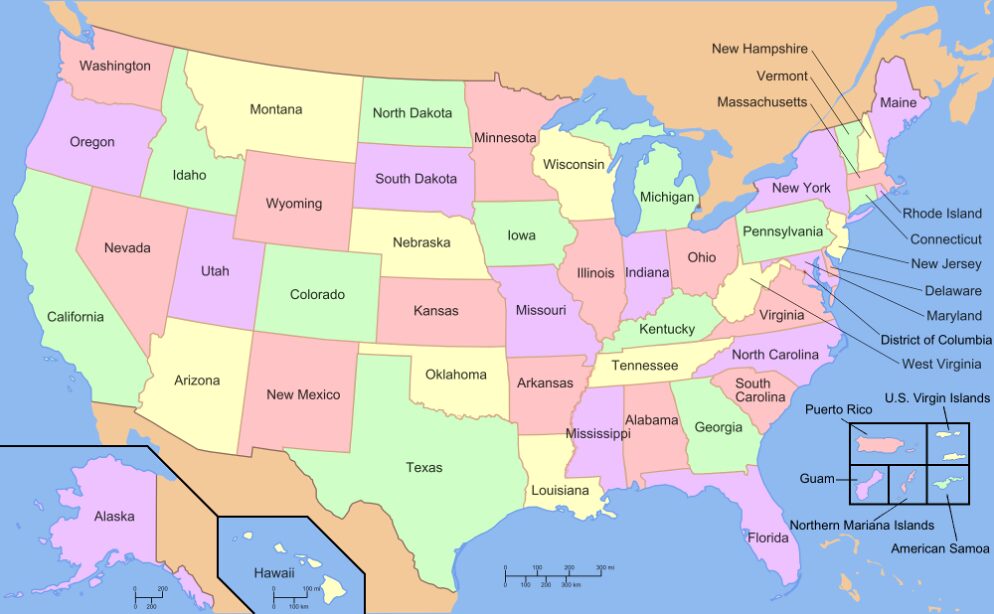
Surprisingly, the closest U.S. state to Africa is Maine, not Florida as many might guess. Despite its northern location, Maine’s proximity to Africa is roughly equivalent to the distance from Florida to California, debunking common misconceptions about geography.
This intriguing fact arises from the Earth’s tilt and the spherical shape of our planet, leading to unexpected geographical truths. The shortest distance between the U.S. and Africa is approximately 5,076 kilometers (3,154 miles), stretching from Quoddy Head in Maine to El Beddouza in Morocco.
Mountains Competing against Mountains
The towering peaks of Mount Rainier in Washington, Mount Elbert in Colorado, and Mount Whitney in California are marvels of nature, each standing within a mere 100 feet of each other’s height, despite their locations in three distinct mountain ranges.
Intriguingly, both the highest (Mount Whitney) and the lowest point (Death Valley) in the contiguous United States are located within the same California county, offering adventurous souls the unique opportunity to explore these extreme places in a single day.
Can’t Build on Water
Despite the common perception that Canada is larger than the United States, when considering land area alone, the U.S. surpasses its northern neighbor. The total area of a country is divided into land area and water area, revealing the crucial detail that places the U.S. ahead.
Canada’s vast lakes and internal waters contribute significantly to its overall size, but when focusing purely on land, Canada encompasses 9.094 million square kilometers, slightly less than the U.S.’s 9.148 million square kilometers. This distinction highlights the importance of distinguishing between total surface area and land area when comparing the sizes of countries.
Pointing in Two Different Directions
Situated in Guam and St. Croix in the Virgin Islands, respectively, these points highlight a fascinating aspect of U.S. territory. This naming coincidence honors the Udall family, prominent in American politics.
While the Point Udall in Guam marks the westernmost reach of U.S. soil in the Pacific, its counterpart in St. Croix claims the title of the easternmost point in U.S. territory in the Caribbean. This curious fact not only showcases the vast span of U.S. territories across the globe but also symbolizes the unity between distant parts of the nation, linked by a shared name and national heritage.
Strangely Shaped States
Arkansas holds a unique geographical quirk among the United States: from any point along its border, traveling due south will lead you into a neighboring state. This includes states that, at first glance, might not seem accessible in this manner due to their position on the map. For instance, although Missouri is primarily north of Arkansas, a journey southward from the town of Piggott in Arkansas will indeed bring you into Missouri.
Each of Arkansas’s surrounding states—Missouri, Tennessee, Mississippi, Louisiana, Texas, Oklahoma, and even the southeastern corner of Kansas—can be entered by heading south from specific points within Arkansas’s borders.
Too Far North is Too Cold
Canada’s population distribution is about 70% of Canadians live south of Seattle, a city known for its northern position in the United States. Additionally, 90% of the Canadian population resides within 100 miles of the U.S. border. This pattern highlights the stark contrast in habitability across Canada’s vast territory.
While Canada extends all the way to the North Pole, claiming a vast expanse of the Arctic, most of its landmass is characterized by extremely harsh weather conditions, making it less suitable for large-scale human settlement. Consequently, the southern regions of Canada, being the warmest and most hospitable, serve as the primary living areas for Canadians.
Try Saying Hexahectaenneacontakaiheptagon Three Time Fast
Colorado’s borders might trick you into thinking it’s a perfect rectangle, but this is far from the truth. The Centennial State is a hexahectaenneacontakaiheptagon, a shape with not four, but 697 distinct sides. This surprising detail emerges from the meticulous examination of its boundaries, which reveal a complex geometry far beyond the simplicity of a rectangle.
Each of these 697 sides contributes to the unique shape of the state, dictated by historical border definitions, natural terrain, and the precise methods used to delineate state lines over time. Colorado’s seemingly straightforward geometry conceals a fascinating complexity.
Self-Sustaining Rivers
Colorado and Hawaii stand out in the United States for a unique hydrological characteristic: they are the only states where every river originates within their own borders. This means that the journey of every river in these states begins from sources located on their own land, be it mountain springs in Colorado’s Rocky Mountains or the volcanic slopes of Hawaii.
Colorado, with its high elevation, serves as a watershed that feeds rivers flowing to various parts of the continent, while Hawaii’s isolated island geography ensures that its rivers spring from local sources before making their way to the ocean.
Some States Are Bigger Than Others
Despite being in the same state as Memphis, Bristol is actually closer to Canada than to Memphis, Tennessee. This intriguing distance anomaly highlights the vastness of the state of Tennessee, stretching over a considerable expanse from east to west.
Bristol, situated near the Tennessee-Virginia border, lies in a position that makes the distance to the Canadian border shorter than the distance to Memphis, located in the southwestern corner of Tennessee. This really emphasizes the unexpected scale and distances that exist within the United States.
If You Want it, You Can Find It!
The United States stands out globally for having an exceptionally diverse climate, more so than any other country. This vast nation experiences a wide range of climatic conditions, from the warm, tropical climates of south Florida and Hawaii to the cold, arctic, and alpine conditions in Alaska and the Rocky Mountains.
This diversity is a result of the country’s extensive geographical spread, encompassing a variety of landscapes and elevations. Such variability allows for a broad spectrum of weather patterns and ecosystems, supporting a wide range of flora and fauna.
The Far Eastern State
Alaska is a state of extremes. Its geographical position at the northwest edge of the North American continent, combined with the vast reach of the Aleutian Islands, underscores its unique standing. The Aleutian Islands stretch across the 180th meridian, placing part of Alaska in the Eastern Hemisphere and making it the easternmost state by longitude.
This feature also secures its position as the westernmost state. Furthermore, Alaska boasts the largest peninsula in the Western Hemisphere, the Alaska Peninsula. The state’s remarkable geographical characteristics cross into both the Eastern and Western Hemispheres.
PART 2 to follow in MAY