


Before you let it spin all day, it’s worth knowing what a ceiling fan can and cannot do.
Some home habits become second nature. You turn off the lights when you leave a room. You lock the front door. And in the middle of summer, you might leave the ceiling fan running, convinced it’ll keep the room cool until you get back. It’s an easy assumption to make—and one that has fueled plenty of debate.
But does leaving a fan on all day work? Read on to learn the truth.
SHOULD YOU LEAVE A CEILING FAN ON ALL DAY?
If you’re not going to be in the room, the answer is no. Despite what you might think, a ceiling fan doesn’t really cool the air. “It’s actually creating the effect of cooling on your body,” says Marlon Chambers, owner of a heating, ventilation, and air conditioning (HVAC) company in Maryland
Here’s why: As air moves across your skin, it speeds up the evaporation of sweat. Chambers likens it to the way moisture-wicking athletic clothing helps pull moisture away from your body. The result? You feel cooler, even though the room itself hasn’t changed temperature.
Your air conditioner works differently. Rather than cooling your body, it’s removing heat and humidity from your home. A ceiling fan can help circulate that conditioned air while you’re in the room, but by itself, it won’t turn an 80-degree room into a 75-degree one. As Chambers puts it, “Your fans are not really cooling the house. You may feel cool because the fan air is moving over you, but the temperature is what it is in the house.”
WHAT ARE THE ISSUES WITH LEAVING YOUR CEILING FAN ON ALL DAY?
If no one is there to enjoy the breeze, leaving the fan running comes with a few downsides.
It increases your energy bill
Ceiling fans are efficient, but they’re not free to run. Most modern ceiling fans, including Energy Star models, use roughly 15 to 100 watts of electricity, depending on size and speed. That may sound small compared with an air conditioner, but it adds up over time.
If a mid-range fan runs continuously for a month, it can consume 50 to 100-plus kilowatt-hours of electricity. That’s enough to add roughly $10 to $20 per month per fan in many U.S. homes, depending on local energy rates. Run it all summer, and you’re easily looking at the cost of a couple of takeout dinners for a room no one is in.
It can actually warm the room (slightly)
It sounds counterintuitive, but every electric motor produces heat as a by-product of doing its job. A ceiling fan won’t turn your living room into a sauna, but it does gently offset some of the cooling you’re trying to maintain.
In a closed room, that small heat output—combined with constant air movement—means the fan is not actively lowering the temperature. Instead, it’s simply redistributing air that’s already there. “There’s no such thing as cool air being created by a fan … only heat being moved around or removed by air conditioning,” says Chambers.
So, while you won’t feel the difference on a thermometer, the idea that the fan is “pre-cooling” an empty room doesn’t hold up.
It adds wear and tear
Like any appliance with a motor, ceiling fans have a finite lifespan measured in operating hours. Most residential ceiling fans are designed to last around 10 to 15 years under normal use but running them continuously accelerates that clock.
Every hour of unnecessary operation adds up: more strain on bearings, more vibration over time, and a greater chance of needing maintenance or replacement sooner than expected. In other words, it’s not that the fan will fail tomorrow; it’s that you’re spending its lifespan while getting no real benefit in return.
It can stir up dust
If blades aren’t cleaned regularly, they collect particles that get redistributed every time the fan spins. That’s more than a cosmetic issue. Dust in indoor air is a known irritant, and for people with allergies or asthma, it can make symptoms worse.
Chambers emphasizes that maintenance matters. “You definitely want to keep it clean,” he says. “The dirtier the fan blade gets, it uses more power to operate that fan.” In other words, dust gets blown around and makes the motor work harder, reducing efficiency.
Chambers recommends cleaning ceiling-fan blades about once a month, or more frequently in homes with pets or high dust levels. It’s a small chore, but one that keeps both air quality and efficiency in check.
WHAT WILL ACTUALLY COOL DOWN YOUR ROOM?
A ceiling fan is still one of the best tools for staying comfortable. However, you must use it correctly.
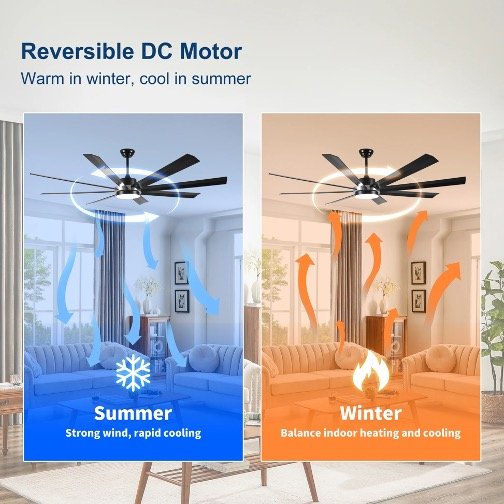
In summer, the blades should rotate counterclockwise to push air downward. Most ceiling fans have a small switch near the motor housing that lets you reverse the blade direction with the seasons. In winter, switching the fan to a clockwise rotation at a low speed helps recirculate warm air that collects near the ceiling.
To help your air conditioner work more efficiently, Chambers also recommends blocking heat before it gets inside. Blackout curtains or shades can reduce solar heat gain during the hottest part of the day, and UV-blocking window film (available at most home-improvement stores) can help keep sunny rooms from heating up as quickly.
WHAT ELSE SHOULD YOU KEEP IN MIND ABOUT YOUR CEILING FAN?
The right fan can make a bigger difference than many homeowners realize. Chambers says people often choose smaller, decorative fans based on looks, but a fan that’s too small for the room won’t circulate air effectively. Larger spaces need longer blades that can move air across the room, not just directly beneath the fixture.
If you’re tempted to leave the fan running while you’re out, you’re not alone. “Quite often we see people who just leave their fan running,” Chambers says. But the cooling they’re counting on isn’t happening. Save the breeze for when you’re in the room and let your air conditioner do the job it was designed to do.