Sealed cans allow manufacturers to control the pressure precisely inside the can, keeping tennis balls at their peak performance level for as long as possible. Here’s why using a can works best.
IT KEEPS THEM BOUNCY
Pressurized tennis balls bounce because the air inside the ball is at a higher pressure than the outside atmosphere. As the ball hits your racket or the court, the pressurized air inside pushes against the rubber and helps it resist deformation (getting squashed), and the ball bounces.
IT STOPS AIR FROM LEAKING OUT
Pressurized balls are sold in a pressured can to prevent the air from gradually leaking out through the porous rubber wall. Tennis balls have a hollow rubber core that is not airtight, and once that rubber core is formed and covered with fuzz, that’s it—there’s no way to pump them up like you can a football or soccer ball.
This is why pressureless balls, which bounce due to their thicker, stiffer rubber instead of an air-pressure differential, are popular for practice and in ball machines. Pressureless balls last longer, because the air doesn’t leak out.
IT PRESERVES SHELF LIFE
Sealed cans keep tennis balls fresher longer. Since a pressurized tennis ball loses air gradually, the old way of packing them in cardboard meant that by the time the balls arrived at the pro shop or sporting-goods store, they were already losing air and bounce. Players had to do a squeeze test to find good ones rather than have confidence that fresh balls were, well, fresh. Today, that’s no longer a worry.
HOW LONG CAN THEY LAST IN THERE?
The Penn balls don’t have expiration dates and nor do the Wilsons. (Wilson is another big name in tennis.) So, in theory they could last indefinitely. But most tennis pros put the window of freshness on an unopened can at anywhere from six months to a year, with two years being the outside limit.
But after you crack it open, the countdown begins. Once opened, balls in pressurized cans can still be used a few weeks later. But you won’t catch a pro using a three-week-old ball at Wimbledon. Those are more for hitting around on a Sunday morning. Even then, after a few hard-play sessions, you’re going to notice a difference in the feel of the ball.
At amateur-competition level, new balls are used for each morning or afternoon event, while at professional level, new balls are used after every nine games. As the ball gets smacked around, the felt cover gets fluffy and slows down the ball as it flies through the air. That’s why professionals take three balls to serve, then throw away the fluffiest ball.
WHAT IS THAT “PSSSSHHH” SOUND THAT YOU HEAR WHEN YOU OPEN A CAN OF TENNIS BALLS?
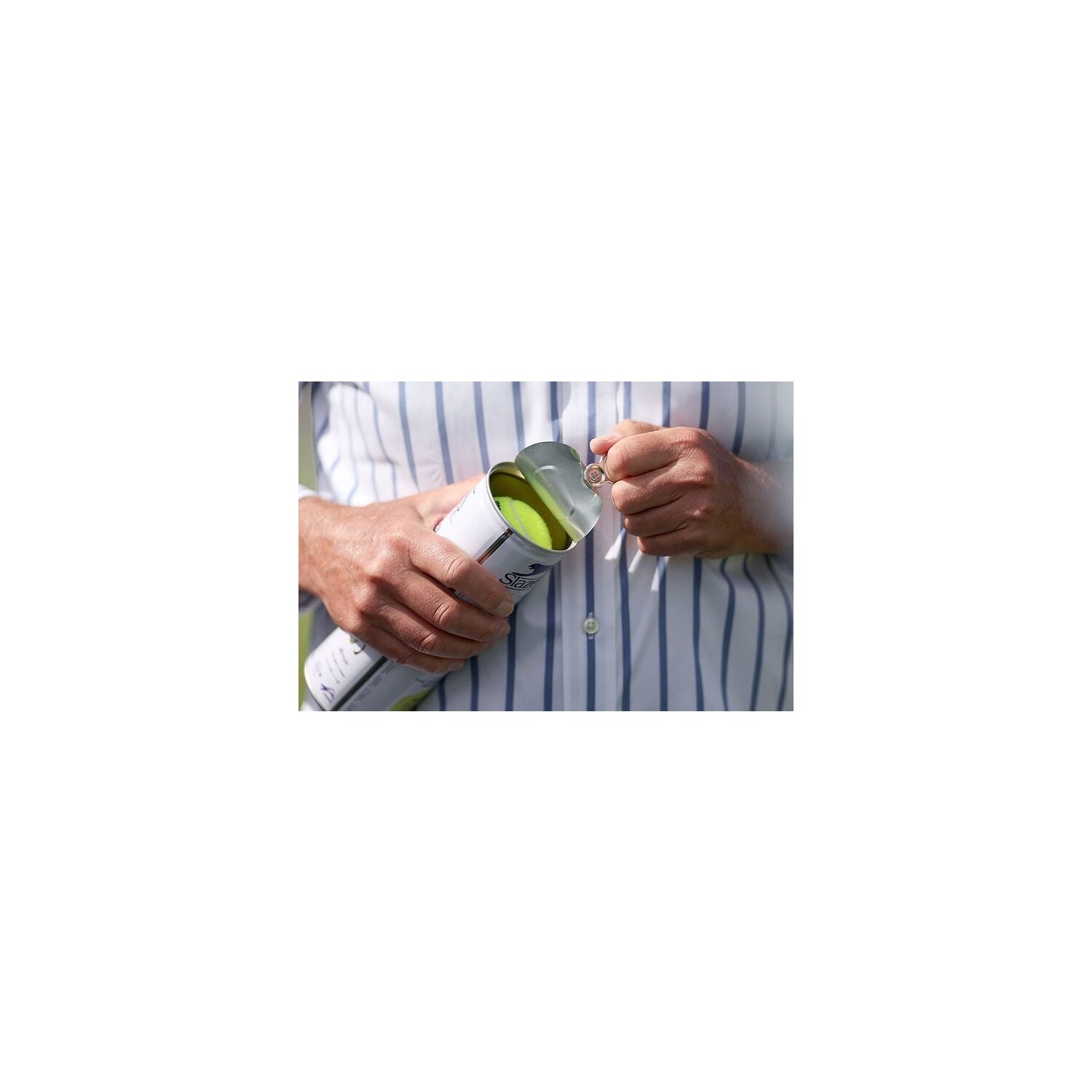
That distinctive whoosh (which is always accompanied by that fresh tennis-ball smell) is the sound of the pressure being released from inside the can. As soon as you pop the top, the higher-pressure air inside the can rushes through the opening to the lower pressure outside, creating sound waves that dissipate as the opening gets larger.
CAN YOU REVIVE A TENNIS BALL?
Yes. It won’t make it as good as new, but depending on your standards, it might be close enough. Old balls can be repressurized by placing them in a pressurized container for a few days, but the outer felt cover will still be fluffy or worn down.
You can find basic pressurizers for less than $20 at Target and Tennis Warehouse, and more sophisticated versions online for about $75 and up.
DO ALL TENNIS BALLS COME IN CANS?
No. Pressureless balls are sold in a cardboard box. Since the air inside them is at regular atmospheric pressure, there’s no need to keep them in a pressurized can. You can also buy pressureless tennis balls in mesh bags, especially if you purchase in bulk.
Pressureless tennis balls are popular in Europe and South America. However, we’re seeing more of them in the U.S., too. Due to environmental concerns over the use of plastic in pressurized tennis ball cans, Wilson developed a new pressureless ball called Triniti that mimics the livelier bounce, faster play, and lighter “feel” of pressurized balls. These are sold in recyclable cardboard boxes.
DO OTHER BALLS COME IN CANS?
Some do, but not many, and the reason is simple: Other balls can be pumped up to the correct pressure with an air pump, though some balls don’t use air or pressure at all. Here’s how it breaks down.
• Padel balls: A very close cousin to the tennis ball, padel balls also have a hollow rubber core and a felt cover. They are sold under pressure in pop-top cans, but they are softer and have more give.
• Racquetballs: The hollow, air-filled racquetball gets its bounce from the rubber shell, not the air inside (much like a pressureless tennis ball). So, while they are often sold in cans to keep the rubber fresh, the cans are not pressurized.
• Pickleballs: The plastic, whiffle ball is hollow and has multiple holes, so it’s just sold in bags, boxes, or other non-pressurized containers.
• Footballs, soccer balls, and basketballs: Larger air-filled balls are sold naked or in boxes and are filled using a bicycle pump or air compressor. These balls will eventually deflate but give them a quick pump and you’ll be good to go.
• Baseballs and golf balls: Solid-core balls do not have air inside at all, so there’s no need to sell or store them under pressure. They may get old and brittle or lose performance capability after years of storage or use, but these balls won’t deflate.