


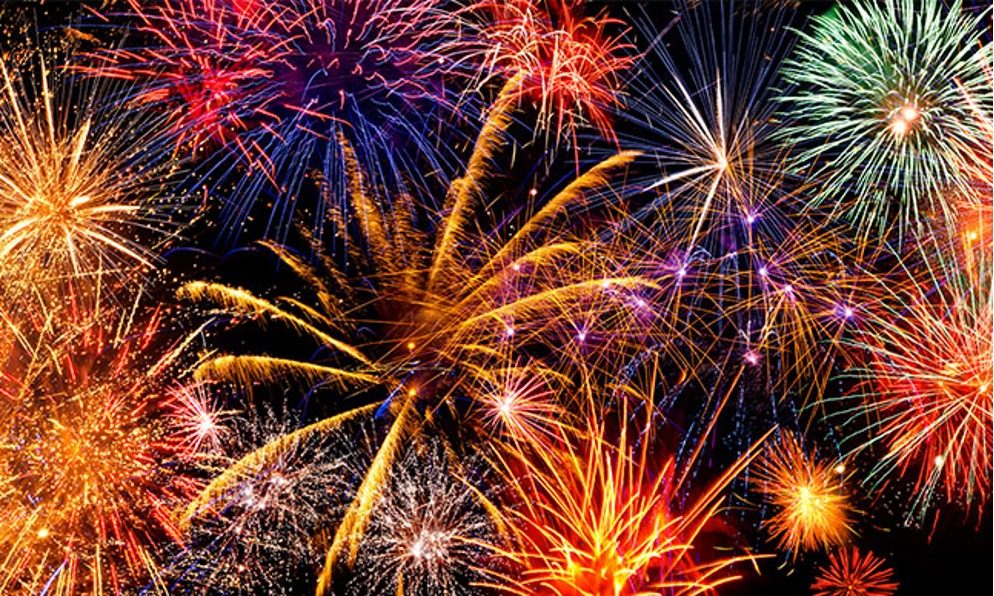
Fireworks are devices used for celebratory purposes both by licensed professionals and consumers and get their propulsion and explosion from gunpowder.
The layout of the contents within fireworks shells produces different patterns, and combining salts with different types of gunpowder produces various colors and effects.
In 2024, 322.7 million pounds of fireworks were used in the US, with the Department of Defense and Disney being the largest buyers.
HISTORY
Fireworks originated in Liuyang, China, where roughly 70% of the world’s supply comes from today.
Over 2,000 years ago, bamboo was observed to explode when burned because of overheating air pockets within the stalks. Believing the explosions could ward off evil spirits, burning bamboo became common in celebrations to ensure good fortune.
For nearly 1,000 years, these rudimentary firecrackers remained unchanged until Chinese alchemists—hoping to create an elixir for immortality—discovered that burning a mixture of saltpeter (potassium nitrate), sulfur, and charcoal created a loud blast.
They had accidentally invented gunpowder, which would become known as one of the four great inventions of ancient China. Bamboo stalks were stuffed with gunpowder to improve their explosive force but replacing them with paper tubes brought about the first modern fireworks.
As knowledge of fireworks spread throughout Arabia, Europe, and later the Americas, the tradition of using them for celebrations spread as well. Before the Continental Congress adopted the Declaration of Independence on July 4, 1776, John Adams wrote that the day would be celebrated with “bonfires and illuminations [a term for fireworks],” setting the stage for Independence Day fireworks displays.
However, it was not until the early 1800s that pyrotechnicians, like the Ruggieri family, mixed other chemicals into gunpowder to create the colorful displays of today.
HOW THEY WORK
All aerial shell fireworks are made of four parts: a lift charge, which propels the firework up when lit; a fuse, which carries the lift charge’s ignition into the shell; a burst charge, which ignites upon being lit by the fuse; and stars, which are pellets that surround the burst charge and fly apart once the burst charge explodes (see visualization).
Stars are organized in an outline of what pyrotechnicians want the explosion to look like. For instance, stars in the shape of a flower will be blown apart in that shape and make a large flower in the sky.
When burned, every element produces a unique set of colors, and stars are created with compounds of specific elements to produce desired colors and sound effects (watch flame test).
Multiple layers of stars around the burst charge or tiers within a shell can create more complex, multipart explosions, with gunpowder consistency altering the burning rate (i.e., finer gunpowder burns more quickly).
For displays, fireworks are loaded into mortars with fuses connected to a remote firing system. The system can be programmed using software to release fireworks at specific times, such as in sync with music (watch a pyromusical display).
HEALTH AND SAFETY RISKS
Fireworks displays must identify exclusion zones to prevent harm from falling shrapnel, which is later collected by pyrotechnicians.
Despite this, from 2014 to 2023, there have been over 112,000 fireworks-related injuries in the US, including inhalation of particulate matter, noise-induced hearing loss, and corneal burns (read about the risks here).
Alternatives, such as drone and laser shows, have become more prominent to minimize these risks and avoid environmental harm.