


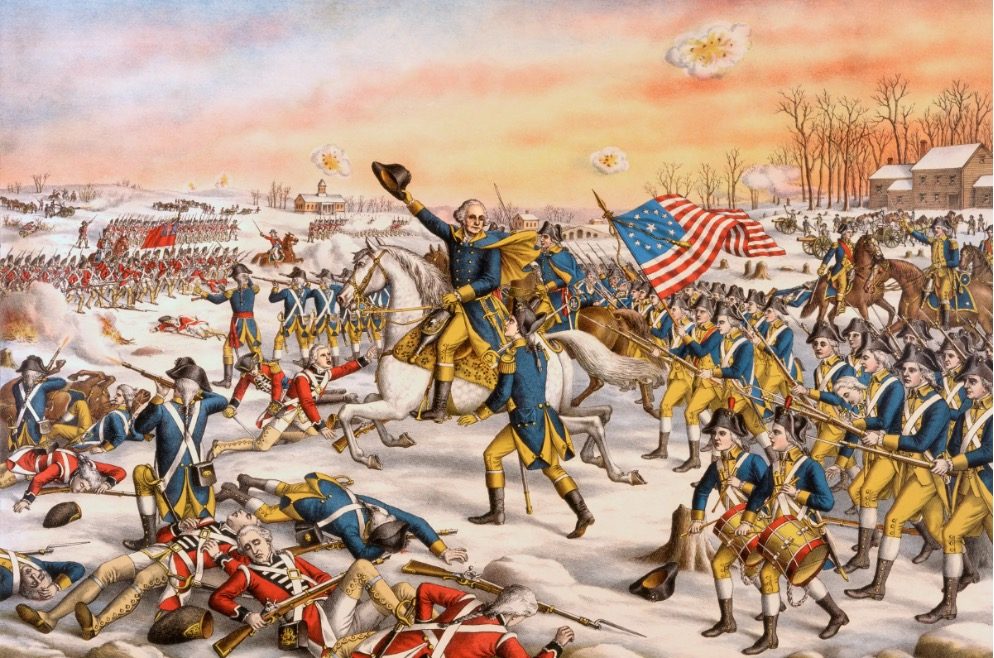
The American Revolution was one of the most significant conflicts of the 18th century. It not only led to the 13 original colonies gaining independence from Great Britain but also helped establish democracy and representation as a path for governments around the world. Today, schools teach the famous events and figures from this chapter of American history year after year, from the rebellious Boston Tea Party to Paul Revere’s “midnight ride” to the “shot heard round the world” during the Revolutionary War. But the storied details of the nation’s founding aren’t always completely accurate, and there are plenty of myths that persist to this day.
Myth #1: The American Colonies Went to War Solely Over Taxes
The phrase “taxation without representation” is a popular and easy-to-remember slogan of the American Revolution, based on the argument laid out in Patrick Henry’s Virginia Resolves in 1765. Henry wrote a series of resolutions that were passed in Virginia’s House of Burgesses in response to the Stamp Act, which levied additional taxes on the British colonies in America. Though taxes were a major point of contention between the colonists and the British crown, they were not the sole reason for the conflict. Mounting tensions between American colonists and the British were also caused by disputes over land distribution — the British planned to reserve the western part of North America
Myth #2: Paul Revere Was the Only Rider Who Warned About the British
Paul Revere’s “midnight ride” was immortalized by painter Grant Wood’s 1931 depiction of the event, “The Midnight Ride of Paul Revere,” which was inspired by Henry Wadsworth Longfellow’s 1860 poem “Paul Revere’s Ride.” While Revere did ride out the evening of April 18, 1775, to warn Sons of Liberty leaders Samuel Adams and John Hancock of the arrival of British troops, he wasn’t alone. Patriots William Dawes and Samuel Prescott also rode on different routes through the greater Boston area. All three riders were stopped by the British but managed to escape and complete their task, warning the rebels that an attack was coming.
Myth #3: The Phrase “Don’t Fire Until You See the Whites of Their Eyes” Was Coined During the Revolution
The phrase “don’t shoot until you see the whites of their eyes” is used as shorthand today, meant as a warning against reacting too quickly. The idiom is typically credited to Colonel Israel Putnam at the Battle of Bunker Hill. However, there’s no concrete evidence that Putnam uttered the phrase, or that it was first said during that particular battle, or even during the Revolutionary War. In fact, some historians have traced the phrase back to the Seven Years’ War a decade earlier, or even to Prussian soldiers during various battles in the 18th century. It’s likely this was a phrase already known to soldiers before the American Revolution.
Myth #4: The Declaration of Independence Was Signed on July 4
Every year, Americans celebrate Independence Day on the Fourth of July, and it’s commonly believed that July 4, 1776, marks the date the Declaration of Independence was signed. In reality, the Continental Congress voted to declare independence on July 2, and the Declaration of Independence was formally adopted two days later on July 4. (John Adams even predicted that July 2 would be celebrated as a national holiday for centuries to come.) The signing of the document, meanwhile, didn’t begin for another month; John Hancock was the first founding father to sign the declaration, on August 2, 1776.
Myth #5: The Liberty Bell Cracked While the Declaration of Independence Was Being Read
No trip to Philadelphia is complete without a visit to the Liberty Bell, a 2,000-pound bell that hangs in Independence Hall (formerly the Pennsylvania State House). The bell was ordered from London by Pennsylvania statesman Isaac Norris in 1751, and when it arrived stateside, it cracked on the first ring. The original bell was then melted down and recast in Philadelphia, and it was this second iteration of the Liberty Bell that was rung to celebrate the first public reading of the Declaration of Independence on July 8, 1776. According to lore, the bell fractured again at this historic moment, but as far as records show, no cracks appeared that day. The infamous split in the current bell actually occurred sometime in the mid-19th century; the first record of the blemish appears in 1846.
Myth #6: George Washington Was a Military Mastermind
The nation’s first President is possibly the most famous American of all time, but he was not quite the military mastermind that he’s often credited as being. Most of the military decisions during the Revolutionary War were hidden from the public, sparing people the details of the indecision that Washington often faced in times of strife. The general had never commanded a large unit before leading the Continental Army, and though his bravery was lauded, his tactician skills left something to be desired, by some accounts. In the years after the war, Thomas Paine — famous for writing the revolutionary book Common Sense — wrote that Washington “slept away [his] time in the field.” That said, Washington’s skills as a leader were unparalleled, and his willingness to step down from the presidency after two terms allowed America’s fledgling democracy to establish a system of shifting leaders.
Myth #7: Americans Were United in Their Support of the War
The “spirit of ‘76” — a nickname for the patriotic fervor around the revolution — was really only a spirit of around 70% to 80% of the population at the time. The rest of the colonists were either loyal to the crown or skeptical of conflict. Some of this divide occurred because of geography, as New England colonists were dragged into the conflict sooner than those in the South. Many people were concerned with the cost (human and financial) of going to war with one of the world’s most powerful empires, and some militia fighters had to be paid to enlist rather than volunteering for the cause. By the end of the revolution, however, enthusiasm for American independence was more widespread. This was due in part to a mass exodus of loyalists: By 1786, between 60,000 and 80,000 loyalists left the colonies to go back to Great Britain.